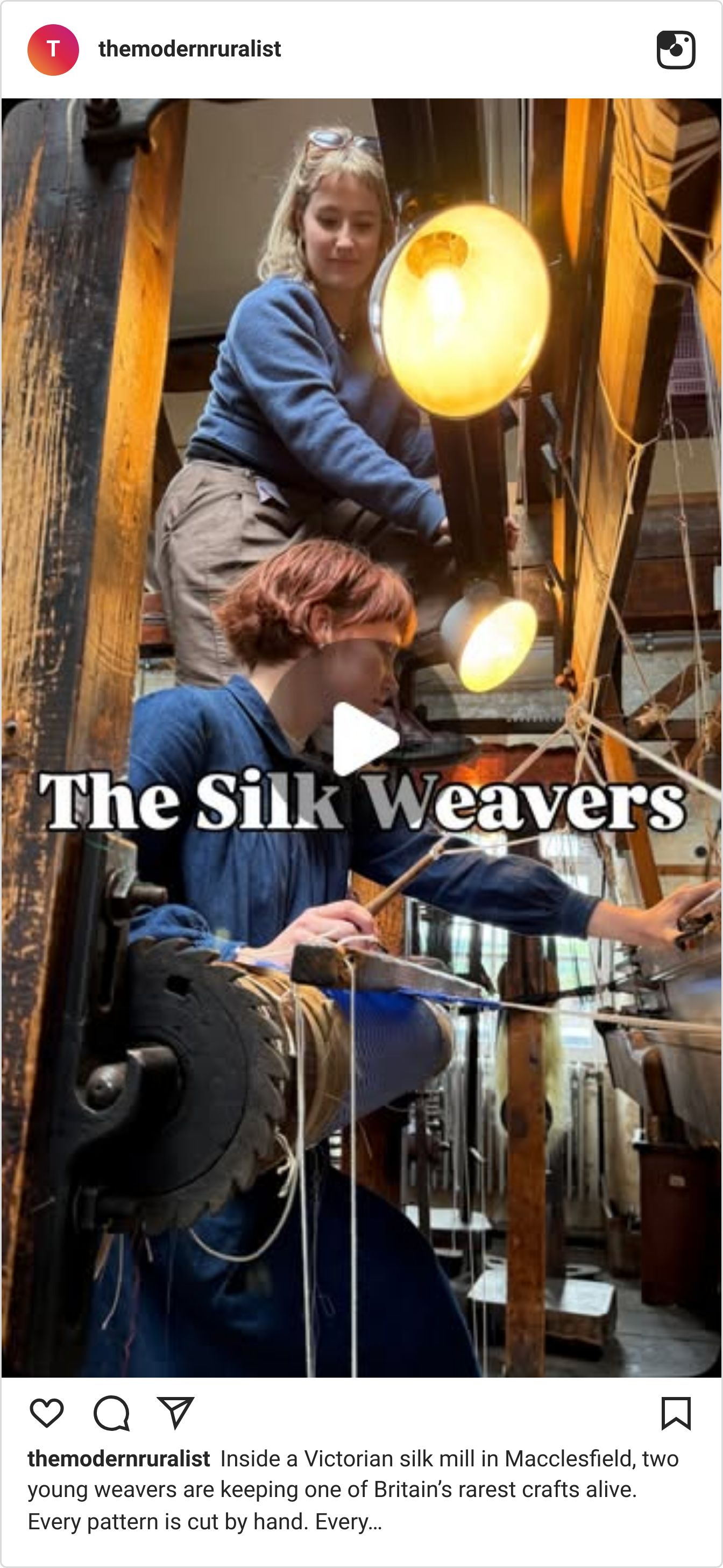
I've spent thirty years following one thread — from fiber to floor to feed — and I'll admit it: Paradise Mill made my heart pitter-patter. Swoon the loom, indeed.

Macclesfield was once the largest producer of finished silk on earth. Paradise Mill, built in 1862, is the last one standing. It ran commercially until 1981, when the weavers and tacklers set down their tools — and the tools have barely moved since. Walk in today and time hasn’t so much stopped as held its breath.
There’s a particular kind of quiet inside an old mill — not silence, but a steady, living rhythm. That rhythm still comes from the Jacquard looms, and from two people: Bea Uprichard and Ruth Farris, who trade as Fishbone & Sycamore — the only heritage jacquard silk designers left in the UK. They’ve spent three years restoring lost skills alongside the mill’s restoration team, learning the hard way what almost no one alive still knows.
Here’s the part that stops a merchant in his tracks. Before they weave a single centimeter of cloth, Bea and Ruth spend weeks on a job most people have never heard of — cutting the punch cards. Not cutting fabric: cutting the cards. Every design has to be hand-punched, hole by hole, into a long chain of stiff cards, and each hole tells the loom which warp thread to lift on which pass. It’s a craft unto itself — historically the “card cutter” was a separate trade from the weaver — and all of it happens before a single row of cloth exists. Those sequences of holes are the design, stored as instructions the loom can read: encoded decisions, repeatable logic, pattern as information. If that sounds like code, it’s because it is. The Jacquard mechanism’s binary system is the ancestor of the modern computer; the punch card ran from this loom floor straight through Babbage and Hollerith to IBM. The machine on the floor of Paradise Mill is, in a real sense, where computing begins.
I’ve built my whole career on that idea — that the discipline underneath the tools doesn’t change even as the tools do. I unplugged a fax machine in 1992 because I could see where the wire was going. Standing in front of a 160-year-old loom, I’m looking at the same truth from the other end: the “innovation” everyone races toward and the “heritage” everyone romanticizes are the same instinct — store the pattern, run it again, make it beautiful.
But none of it survives on nostalgia. It survives on economics and hands. They weave 100% silk scarves and neckerchiefs from deadstock silk, using only processes passed down since the 18th century — and every commission is a vote for the craft continuing. That’s the merchant’s real point: preservation isn’t a museum, it’s a business decision, made one purchase at a time. When the last person who can cut a punch card retires and no one has bought enough to fund an apprentice, the skill doesn’t fade — it’s simply gone, and no algorithm rebuilds it.
So no, the headline isn’t “Jacquard looms influenced computers.” The headline is that the first computer is still running, by hand, because two people decided it should — and whether it’s still running in twenty years depends on whether the rest of us treat cloth we can feel as worth paying for.
That’s the whole thread, from fiber to feed. Some of the most meaningful innovation left is simply refusing to let the pattern go.
Meet the makers: Bea Uprichard & Ruth Farris of Fishbone & Sycamore, handweaving at Paradise Mill, Macclesfield. Original reel here.