

Fifty years of finding rather than inventing — and what a product director sees in a North London workroom
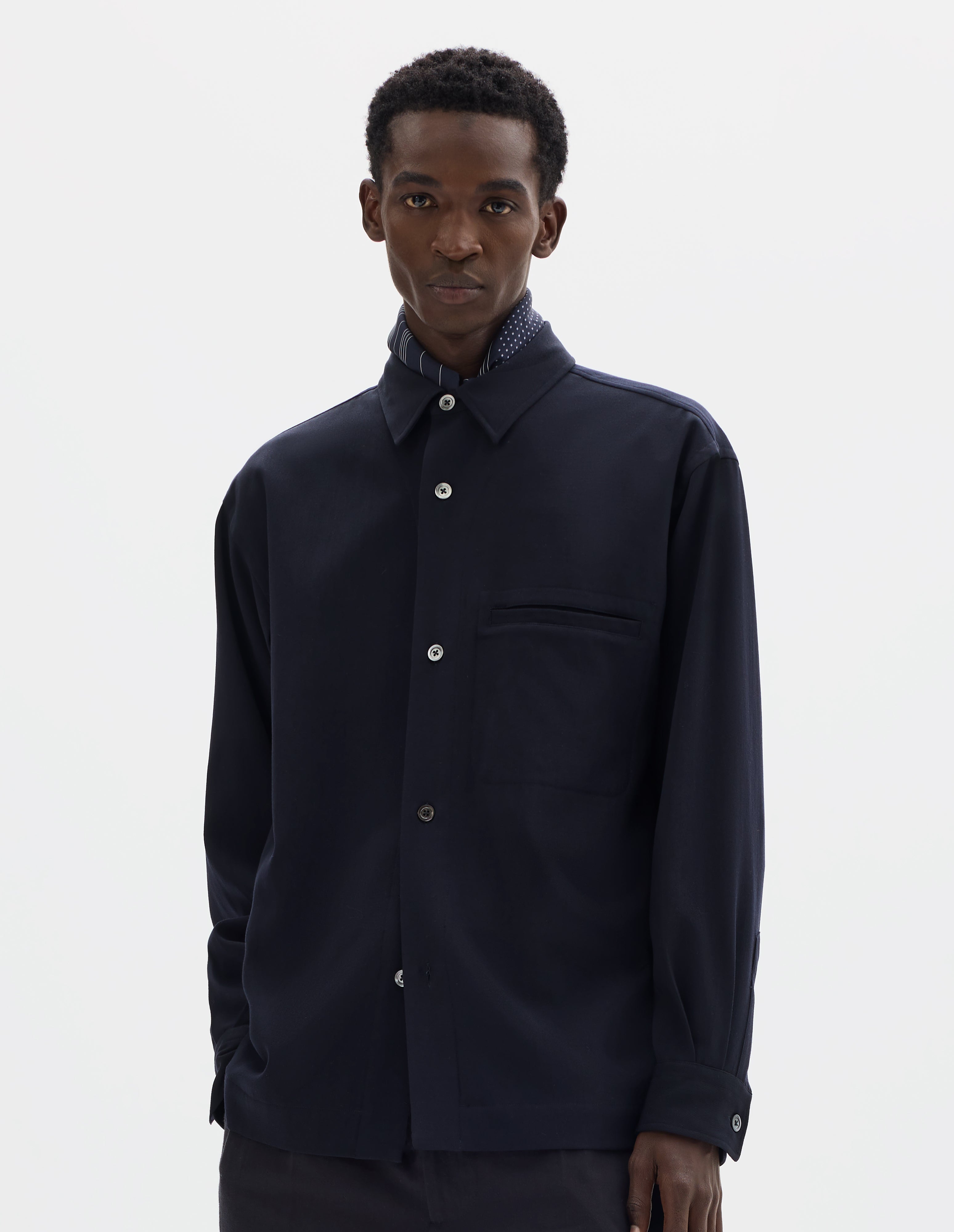
In 1970, a fine art graduate from Goldsmiths bought a shirt at a jumble sale. It was a soft 1920s pinstripe, unstructured, with tiny stitching, and it had been made beautifully by someone whose name she would never learn. She did not think how do I improve on this. She thought: I would love to make a shirt like this.
Fifty-plus years later, Margaret Howell has just opened a dedicated shirtmaking workroom in North London and given it its own label. The circle closes almost too neatly — bedroom to workroom — and every write-up will reach for that line, mine included.
But I want to argue something less romantic and, I think, more useful. Because I have spent thirty years running product inside British and American heritage houses, and what I see here is not a lovely story about craft. It is one of the most disciplined operating models in the industry, sustained for half a century without a single fashionable swerve.
Which is worth being precise about, because the two roles are not the same and the difference is the whole point of this piece. She is a maker who had to learn the commercial architecture in order to stay a maker. I come at it from the other end: my job is to take what the makers and designers find and get it briefed, costed, planned, produced and sold — without breaking the thing that made it good in the first place.
Different starting points, identical discipline. And at the highest level the distinction dissolves entirely, which is the real lesson here: neither half of the job can be decided by somebody who does not understand the other. Every failure I have been called in to fix has been a version of that one mistake.
It is also, if I am honest, the model I have spent my career trying to build for other people.
1. The found object is a brief, not a mood
Start with the jumble sale, because everyone misreads it.
The usual reading is inspiration — designer sees beautiful old thing, feels something, makes new thing. That is not what happened. What she found was a specification: a particular softness, a particular collar behaviour, a particular stitch density, a fabric that had already proved what it would do after two hundred washes. British shirting at the time was stiff, starched and corporate. The flea-market shirt was evidence that another answer had already existed and been abandoned.
I have made a career out of exactly this motion, and I have come to believe it is the most undervalued skill in product. The best idea available to a business is almost never a new one — it is an old one that stopped being looked at. I have opened boxes in archives and found packaging that sold construction like a spec sheet: fabric weight, seam type, pocket depth, residual shrinkage as a percentage. I once found a mid-century card advertising a garment cut in graduated proportions so it would fit tall, medium and short men. That is inclusive sizing, sold as a consumer benefit, decades before the industry decided to have the conversation.
Nobody had to invent it. Somebody had to find it.
Howell's fine art training matters here, but not for the reason usually given. It taught her to treat a garment as an enduring functional object rather than a seasonal statement — which is a product person's instinct dressed in an artist's education. And it produced the line I would put above my own desk: she has said she does not like absolute perfection. Her trousers are meant to be washed, creased and broken into.
That is not modesty. That is a designer specifying the finished state of a garment three years after purchase — which is a far harder brief than specifying how it looks on a hanger.

2. In-housing is artistry, not margin
Now the operational move, which is the genuinely radical part.
The overwhelming majority of clothing is made by third parties, and there are good reasons for that — capital, flexibility, capacity, risk. Opening your own shirtmaking workroom in North London in 2026 is, on a spreadsheet, close to indefensible. Domestic labour, fixed overhead, capped capacity, no ability to flex down in a bad year.
So why do it?
Because some things cannot be bought at arm's length. You can buy a fabric. You cannot buy a stitch length that nobody thought to specify. The "tiny stitching" she fell for is exactly the kind of detail that erodes quietly through a supply chain — not through bad faith, but through a hundred small reasonable substitutions, each one defensible, cumulatively fatal.
I have spent years on both sides of this. I have built a fully vertical operation — design through to receipts — and I have run a business almost entirely on cut-make-trim through dozens of independent makers. Both work. But they are not the same instrument, and the choice is not really about cost:
Outsourced production buys you optionality. You can chase volume, flex capacity, and move.
Owned production buys you the right to be specific. And specificity, held for fifty years, is the only thing that eventually becomes inimitable.
Framing this as "vertical integration for artistry, not margin" is right — but I would go further. It is vertical integration as a memory system. A workroom is where a house keeps its know-how somewhere other than in documents. That is a strategic asset, and it does not appear on a balance sheet anywhere.
3. She scaled the block. She did not redraw it.
The part of the story I find most instructive is the trousers, and it is the part most often skipped.
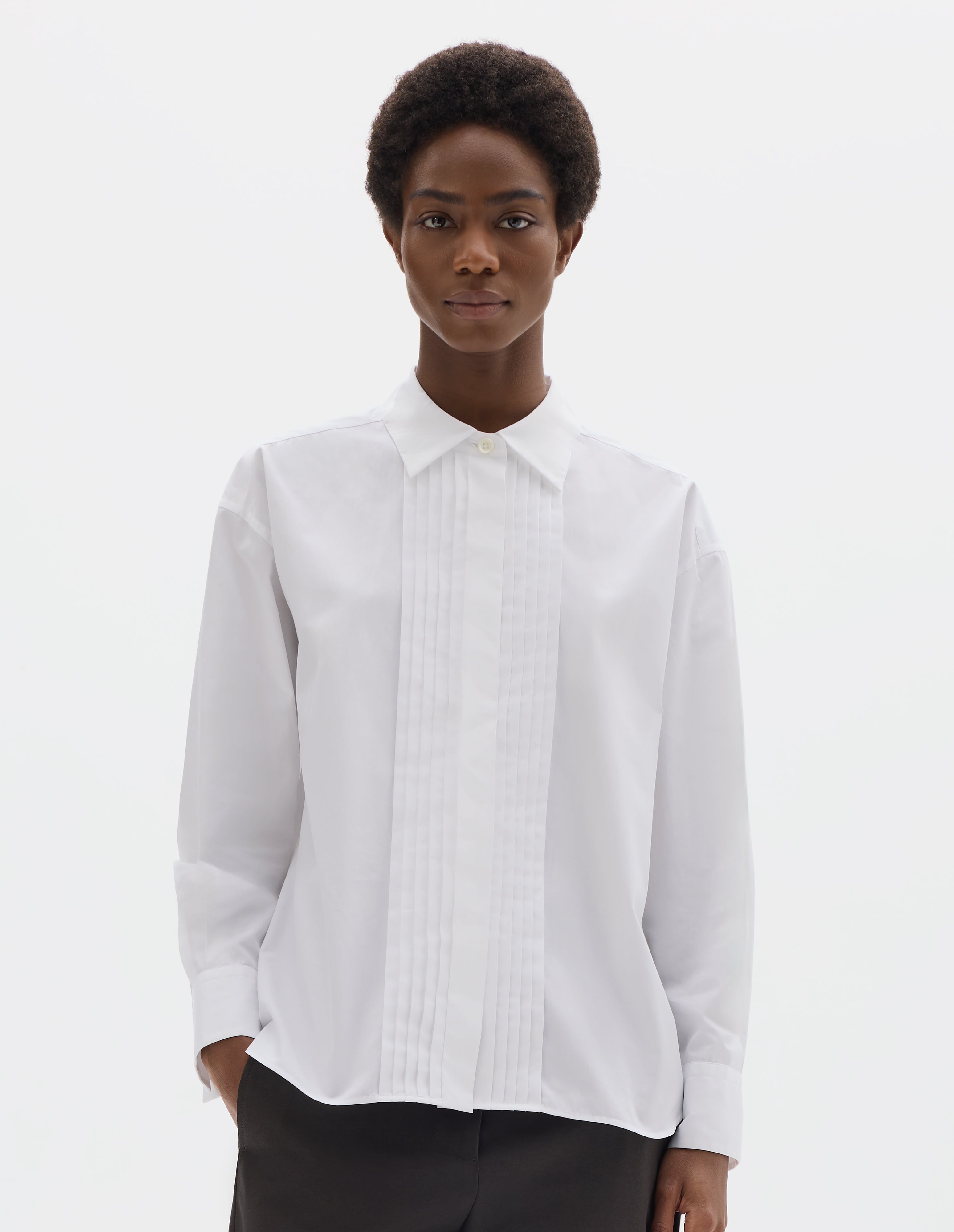
When women moved decisively into trousers in the late seventies, the industry's instinct was to design women's trousers — which in practice meant lighter cloth, shallower pockets, prettier finishing and less of everything. Howell took men's trouser blocks and scaled them, keeping the deep pockets, the substantial waistband, the heavy pleating, the reinforced seams. The result has barely moved in forty years.
I have built fit architecture for a living, and I can tell you precisely why this is clever. A block is not a shape. It is an accumulated body of solved problems. Every seam allowance and grade rule in a mature men's trouser block encodes decades of learning about wear, stress and repair. Redrawing it from scratch in the name of femininity throws all of that away and calls the loss a design decision.
Scaling it instead does three things at once: it preserves the engineering, it produces a genuinely relaxed and androgynous silhouette, and — the commercial part nobody mentions — it collapses your development burden. One well-understood block, honestly graded, will outperform two half-solved ones every single time. I have watched teams spend a fortune discovering this the expensive way.
And it explains why the chinos work. Post-war British military uniform and industrial workwear are the source; heavy cotton drills, reinforced seams, buttons sewn to survive. Utility is not being referenced. It is being obeyed. The decoration is the function — which is the only kind of detail that still looks right in a decade.
4. Two vocabularies, held apart on purpose
The MHL. split is a piece of merchandising I would teach.
Most houses that add a second line do it for reach — a cheaper version of the same thing, which reliably damages both. The split here is by vocabulary, not by price: the mainline holds refined detail and serious cloth, tweeds and cashmere; MHL. takes the rugged, indigo, hard-wearing utilitarian register. Two coherent points of view, each free to be fully itself.
And now the London Workroom label sits above, doing something different again — not a broader tier but a narrower one. It names who made the shirt and where. In a market saturated with claims, a label that functions as a receipt is worth more than any amount of storytelling.
Having spent a career on the arithmetic of range architecture, I would put it plainly: tiering only works when each tier answers a different question. If your tiers differ only by price, you have not built an architecture, you have built a discount. Every tier here is answering a genuinely separate question — how refined, how rugged, how traceable — and that is why the structure has held.
5. The condition of sale
The eighties took a great many independent designers, and this one nearly went too — partnership dissolution colliding with an industry contraction. What followed is the least discussed and most important act of the whole fifty years.
Japanese partnership, then majority stake sold to a listed Japanese company — with creative control retained absolutely.
That is not a footnote. That is the entire brand, negotiated as a term sheet. Capital arrived, distribution arrived, the Tokyo consumer who understood a hyper-specific British aesthetic arrived — and the one thing that could not be traded, wasn't.
I have sat in enough rooms to know how rare that is, and how rarely it survives contact with a second decade of quarterly reporting.
6. The only moat that compounds
Which brings me to the number that ought to unsettle the industry: her customers reportedly keep and wear these clothes for more than five years, in large majority.
Read that as a product director and it is quietly devastating. Longevity of wear is the one competitive advantage that cannot be copied by spending money. It is not a marketing position or a sustainability claim. It is an outcome that requires the cloth, the block, the construction, the restraint and the fifty years to all be true simultaneously. You cannot buy it in, and you cannot accelerate it.
It is also the exact opposite of how most ranges are planned. The default reflex when growth stalls is more options, more newness, more churn — and each round trains the customer to wait for the next thing. Here the absence of change is the product.
Which is why the shops look like modernist furniture galleries rather than clothing stores, and why the right description is not fashion designer but curator of a considered lifestyle. She is not selling garments. She is selling the proposition that you can get dressed the same way for thirty years and be right every time.
The bit where I declare myself
I should be honest about my bias, because it is total.
I am a jean-and-tailored-jacket person — trousers, the perfect t-shirt, a fine merino layer, the best outerwear I can find, shoes that are comfortable and handsome. I dress in uniforms of my own devising and have never once regretted it. This is a house built for how I actually live. I'd happily be buried in it. I've made my wishes known.
But set the personal admiration aside, because the professional case doesn't need it.
What I've described in this piece — a found object treated as a brief, a workroom that keeps knowledge in hands rather than documents, a block scaled rather than redrawn, tiers that each answer a different question, control retained as a condition of sale, five years of wear as the outcome — is one continuous chain. Research, then story, then plan, then make, then sell. Fifty years of it, unbroken, with no link outsourced to fashion.
That chain is my whole trade. I find the thread, follow it, hand it to the people who will make it, and get it sold. Do that once and you have a good season. Do it for fifty years without dropping a link, and you have a house.
Most of the industry is trying to invent its way to that. She simply went to a jumble sale, found a shirt somebody had already made properly, and never stopped paying attention.
That is the long game. It is also, I'd argue, the only one.
Sources for the historical detail: interviews and profiles in Vogue UK, The Guardian, Monocle, Mr Porter and Highsnobiety, alongside the brand's own account of its founding. Where a figure is reported rather than published by the company, I have said so.
Note: I used AI (Claude) to help structure and edit this piece, drawing on my own portfolio and experience as source material. The ideas and voice are mine.