


There are accessories, and then there are accessories that carry centuries.
In Ralph Heimans' portrait of Prince Philip, Duke of Edinburgh, created to mark his retirement from public duties in 2017, the eye is first drawn to the grandeur: the polished corridor, the Windsor setting, the long perspective of history. But then comes the color. A pale blue sash cuts across the dark formality of the Windsor Uniform, soft and luminous against all that ceremony.
That sash belongs to the Danish Order of the Elephant, Denmark's highest chivalric order. Its badge — an elephant — is one of those rare details that feels both deeply traditional and surprisingly fashion-forward. It has weight, wit, and silhouette. It is not merely decorative; it is identity rendered as styling.
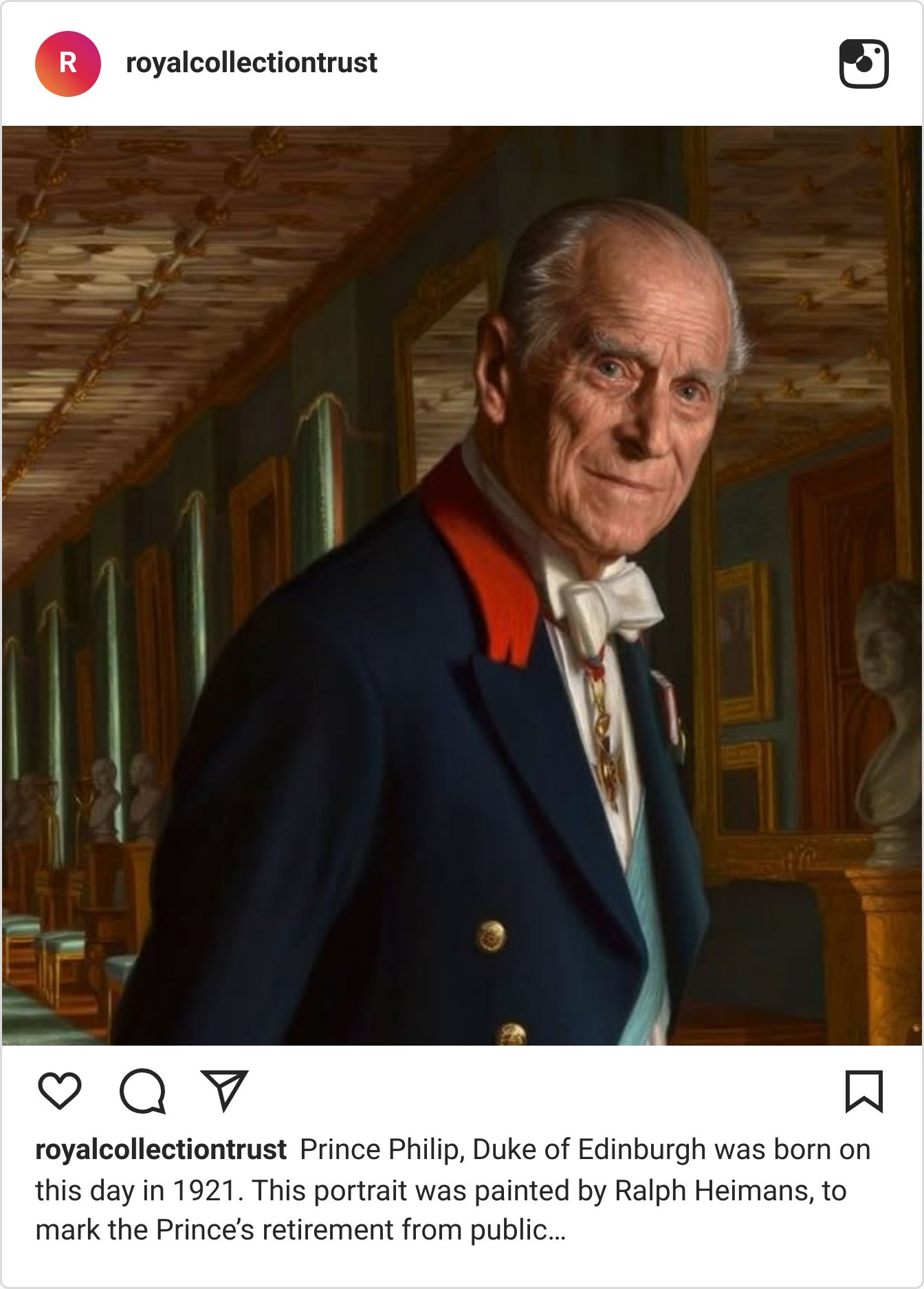
For Prince Philip, the order was more than an honor pinned to a uniform. It connected directly to lineage. He was born a prince of Greece and Denmark, and the portrait's setting reinforces that ancestry. The Grand Corridor at Windsor Castle leads the viewer back through a family map: George I of Greece, Queen Alexandra, Princess Victoria of Hesse, Princess Alice of Battenberg. The hallway becomes a bloodline. The sash becomes a signpost.
This is where the portrait becomes unexpectedly modern. Fashion, at its best, is never only about what looks good — it is about what a detail can hold. A cut, a color, a badge, a jewel, a sash: each can become a code. In this painting, the pale blue is not just a flourish. It is biography and diplomacy and inherited memory, made visible.
And the elephant? That is the part that refuses to leave you alone.
Because there is something wonderfully specific about it. The Danish Order of the Elephant refuses anonymity. It does not disappear into the polite language of medals and ribbons; it arrives with an animal symbol, a sculptural badge, and a color story that makes the whole portrait sing. Against the formality of Windsor, the elephant introduces imagination. Against the weight of dynastic history, it brings charm.
That is the power of a great fashion detail: it can soften authority without weakening it. It can make history feel alive, tactile, almost wearable. In Heimans' portrait, Prince Philip is not simply shown as a retired public figure. He is staged as a man made of crossings — Greece, Denmark, Britain, monarchy, marriage, service, family, ceremony.
The pale blue sash tells that story before a single caption does. It is proof that style can be archival — that a portrait can be read like an outfit, and that the smallest, most precise detail may carry the largest inheritance.

Celebrating the Artisans, Innovators, and Visionaries Who Shape Our World (including me)
